
Bots in the Beerlight
Sometimes embodiment is all you've really got
Alex Rapine’s Bar Tab is a good newsletter I’ve recommended before that posts pretty infrequently, with Rapine reviewing bars in New York (and occasionally in other cities) from the perspective of actually understanding what makes a bar enjoyable to be at, an approach that is less common than you might think. One memorable post of his, about the Bushwick bar Carousel, discusses the still-rampant profusion of ‘70s-themed bars in Brooklyn and the contradictions of that aesthetic—which, by now, seems to have fully decoupled from its referent and become its own self-contained universe that feels quite contemporary, drained of whatever nostalgia originally inspired it. Rapine quotes his father, who after visiting a few such ‘70s-themed Brooklyn bars offers this assessment: “So in other words they are bar themed. This is what bars have always looked like and still do.”
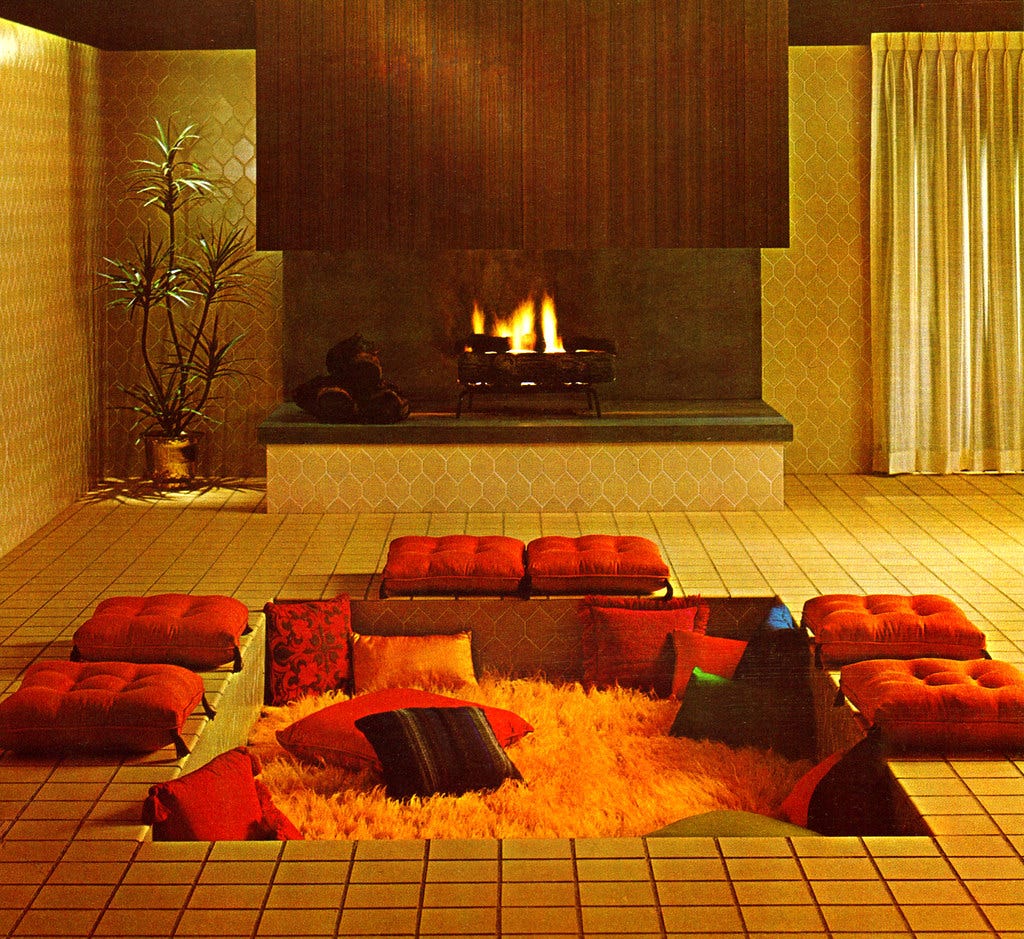
Carousel, which I’ve never been to, has a conversation pit, an interior design feature that seems to have become a meme in its own right, a perennial object of social media desire (although this could just be bots yearning for the embodiment that would enable them to lounge in the pit). Conversation pits are certainly photogenic but I’ve always suspected they went away for a reason. Rapine concludes his post with this note on Carousel’s version:
“The conversation pit can be reserved in advance because of course it can…Why in a world where I select my movie theater seat and make dinner reservations one month ahead of time exactly as they become available to me via Resy would I leave an evening out drinking up to chance?”
I think about this line quite often—this idea that the spread of reservations into new spaces is an anxious rejection of uncertainty and spontaneity in domains that ought to be carefully stewarding those resources—and I recently thought of it again when my main neighborhood spot started accepting reservations for tables during Knicks playoff games.
Part of what I like about this particular bar, which I’m not going to name—not that me doing so would make anyone want to go—is that it’s relatively normcore (in a way elaborated here and here) and thus not at risk of ever blowing up in the TikTok-popularity sense. It’s not photogenic, but also not a “dive bar,” and the food is fine, and the prices are slightly too high and the beer selection leans toward millennial-core IPAs. This bar is not quite anything, really—not even quite a sports bar, although it is more of one than anything else nearby, hence its popularity during Knicks games and other peak sports moments.
What is really special and unique about this place, though, is that it’s very close to my apartment.
Ultimately, I don’t want to watch a basketball game surrounded by people who made a reservation to watch a basketball game, and certainly not at a place I am accustomed to drifting in and out of as I please with minimal friction. But I get it. The Knicks reaching the Finals meant unprecedented explosions of brief demand for spaces that will be quite empty again next month when the World Cup is over and there’s nothing on their TVs but a Pirates-Brewers day game. So you can’t fault people for wanting to make reservations, or bars for accepting reservations. I just won’t be there at those times. And that’s probably the idea—give the spot to someone who wants it more.
I don’t really mind this, but it seems more likely that I’ll have to make reservations at this bar again in the future, now that they’ve set up the infrastructure for it, and this happens to be the one place where I value spontaneous coming and going the most. My best hope is that the place never becomes more popular—which to be fair, it probably won’t.
THE ARISTOCRACY OF THE REGULAR
New York, like many other cities, requires its inhabitants to navigate spatial scarcity and the various systems that manage excess demand for limited space (an example of which I’ve just described). Reservations are one such system, as is waiting in line for something. High prices and exclusivity are two more. Another system, crude but enduring, is straightforward crowdedness—the anarchic non-system that just lets everyone figure it out for themselves. Each has its advantages and disadvantages, which probably came to mind as you read this list. And, as I recently wrote, you might adapt yourself to these conditions over time by “intentionally avoiding and grouchily rejecting things that seem broadly appealing, or otherwise randomizing your schedule to decouple it from peak demand.” Hoping that your favorite places don’t attract more customers is related to this attitude.
Lately, these various systems for managing and allocating scarce consumer experiences—particularly the sudden proliferation of long lines for treats—have become objects of broad interest, accompanied by effervescent cultural commentary. A few years ago, the ascent of Resy and other digital reservation platforms got a similar examination in the discourse. If NYC is a laboratory for refining new crowd management techniques, then we seem to be in an extended period of innovation (and like so much else, the pandemic accelerated what the internet had long ago started).
“Line culture” is obviously not just waiting in lines, which we have always done, but a new openness to something we used to instinctively dislike and avoid whenever possible. Blackbird Spyplane, pondering the phenomenon recently in a post titled “Why are we addicted to standing in line for treats?” posits that these queues “were invented by market forces during the rise of Millennial purchasing power,” another product of ZIRP froth, and that their essential mechanism is “infusing a regular line with the sort of eager anticipatory energy that was once restricted to actual events,” thereby turning everyone into a tourist.
The essay’s tone is ambivalent, first seeming to criticize the emptiness of “line culture” while admitting occasional participation in it, but ultimately empathizing with the line-waiters, perhaps too generously, suggesting that we seek embodied, communal experiences in physical space endowed with an aura of meaningfulness, and that waiting in the treat line fulfills this need. Also, the lines are egalitarian:
“You don’t need a ton of money or elite connections to score a Japanese-style Basque cheesecake ‘everyone is talking about.’ You just need to wait your turn. There are people who pay other people to wait for them, and there are entire resale economies centered on coveted non-perishable treats. But while that is bleak, it doesn’t undo the intrinsically egalitarian nature of the line. (At least until the airportification of all life is complete and they figure out how to put ‘platinum-tier’ expedited lines everywhere.)”
Resy is also egalitarian, in theory: Just as anyone can wait in line, anyone can make a reservation, or at least has the same opportunity to make one when they become available. There are notable exceptions to this, which I’ll get to below, but in their platonic form, reservations and lines are both democratic, working similarly for everyone.
What is not democratic, on the other hand, is being a regular somewhere. At a given establishment, not everyone has a realistic opportunity to become a regular. The regulars usually live nearby, so they have better access to the place than everyone else, which is not fair, and they are also usually treated better by the staff than non-regulars, which is even less fair. The regulars also tend to know one another, so they have a better time. As I mentioned above, these are some of the main reasons I like hanging out at [redacted] and regularly choose it over other “better” options. This bar’s embrace of reservations during Knicks games unsettled me not because it prevented me from going (I could have just made a reservation myself) but because it foreshadowed a world where the playing field is leveled in alarming fashion and my special status is diminished. Again, my only hope is that it never becomes popular in the way it was during the 3-hour windows when the Knicks were playing (and again, it probably won’t).
If the aristocracy of the regular crowd is inherently not egalitarian, then neither are reservations and queues, both of which simulate equal opportunity and fairness while smuggling in less transparent forms of favoritism through the side door, often literally. Reservations have always been subject to favoritism and preferential treatment, just as knowing the right person or being otherwise special often lets you skip the line. Digital reservation platforms like Resy add another unequal layer on top of this, offering special access tiers (to AmEx card holders, for example), and there are also members-only reservation apps with their own special access, as well as secondary markets where all of these reservations are bought and sold like the commodities those platforms have made them into. The queues at airports and amusement parks are similarly bifurcated via FastPass systems and loyalty programs—something the Blackbird Spyplane essay alludes to in its remark about how the “airportification of life” will result in “‘platinum-tier’ expedited lines everywhere”—which reads like a joke until you think about it a bit more and realize that is probably what will indeed end up happening in many instances.
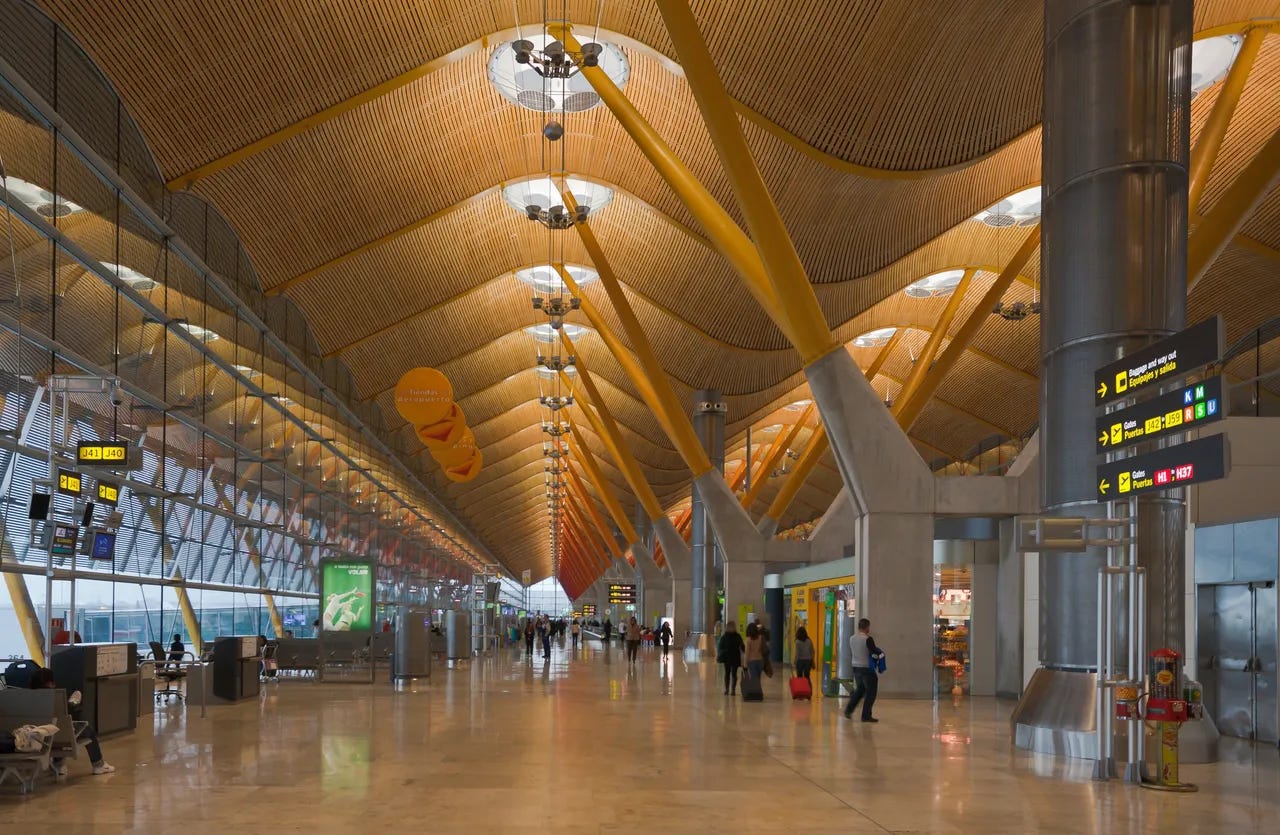
Reflecting upon the above, it seems like these demand management systems progress through three stages:
The unmanaged crowd (first come, first served)
Reservations and queues (when the crowd becomes difficult to manage, or when more risk-averse customers demand a legible system)
Airportification (formalization of tiered access)
The “regular crowd” forms and flourishes in Stage 1, and is progressively undermined in the later stages. There are no “regulars” in an airport lounge, just Diamond and Platinum members. Resy dissolves borders and opens up new commodity markets: the perfect neoliberal instrument.
EMBODIMENT AS EDGE
This progression from Stage 1 to Stage 3 is also a passage from embodied individuality to disembodied fungibility. In the beginning, you are a person physically showing up somewhere, being seen, speaking to those around you, and navigating a particular environment; by the end, you are effectively reduced to your digital footprint, only distinguishable from a bot by your ability to solve a CAPTCHA (even if you still eventually show up to the physical place you’ve made the reservation for). In between those two end points, you might occupy an appropriate intermediary state: waiting in a line with a bunch of other people who are undifferentiated from you in any meaningful way.